

The star has given the full amount of his twenty-five thousand pound Mercury Prize cash to the trust for venues, which functions to preserve the UK's small music venues.
He was awarded the prize on October 16 as his new release his work was chosen as the best record of the previous year.
He has opted to hand the money over to the MVT, in appreciation of the vital role local spots had in his early career.
"I wouldn't be doing my current career if it wasn't for all the performances I did around the region, and beyond, when I was just getting going," stated the artist. "These locations are iconic, but they are in difficulty."
Since the start of 2023, more than 150 of these venues have permanently closed – about one-sixth of the total UK scene.
In the last year, major artists like the band Pulp, Coldplay, the singer Katy Perry and Ed Sheeran have all aided the MVT in its efforts to support the industry, by applying a modest fee to their admission fees, which benefits independent venues.
Sam Fender also participated, generating in excess of £100,000 on his 2024 arena tour to assist numerous small stages across Britain.
These funds supported spaces that were confronting possible closure due to challenges arising from flooding, blazes and personal losses, as well as permit problems, legal disputes and neighbor objections.
Additional spaces obtained monetary aid in improving facilities and sound and lighting systems that directly benefitted artists and concertgoers.
"The concept that money from shows in major spaces supports the local stages, where it all starts for artists like me, is just logical," Fender has said.
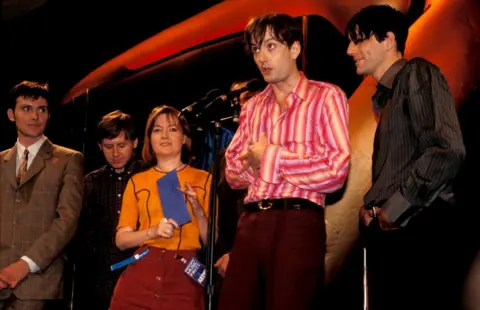
The musician is not the first artist to give his Mercury Prize winnings to worthy causes.
In the band earned the prize in 1996 for their release Different Class, vocalist Jarvis Cocker announced that the act would contribute their winnings to the charity War Child.
In 2002, musician Ms Dynamite split her bounty among several good causes, like the children's charity and a Sickle Cell organization.
"Additionally, I contributed a thousand pounds to the center, to their classes, because I did gymnastics when I was growing up and they needed better apparatus," the artist explained to a publication.
In recent years, the band donated their winnings to the youth organization that nurtured their act, alongside other grassroots music organisations.
Also 1994 winners the group gave their prize to a multiple sclerosis charity after a acquaintance was found to have the disease.
"Receiving the award was quite enough," remarked singer Small. "The money was the bonus but we could do without the cherry, because we had the honor. So our winning affected another person's life."
Last week, the trust revealed it had rescued several small stages in south-east England, by placing them under public stewardship.
The first in that area and the other in Bristol were purchased under the community ownership initiative, which is supported by the arts council and supporters who purchase "shares" in the buildings.

